Issue 0004: Naval’s Leverage Pyramid and AI
Picking up Brass by Hand
Range days were some of the best days in the Army. You spent the day outside, moving, shooting, and doing what you signed up to do. For people who never served, the picture in their head of what it’s like to be in the Army is probably a day at the range. For soldiers, it's only a fraction of what you do. There were weeks when we went to the range every day, and there were months when we didn’t go once.
Every range day ended the same way: brass cleanup. There were no special machines and no automation. The Army has its own technology: soldiers. So at the end of the day, everyone got on their hands and knees, used their patrol caps as a basket, and combed through the dirt for spent brass. It took an hour, sometimes more, depending on how much we'd fired.
I had mixed feelings about brass cleanup. There were moments I'd think, we have GPS, drones, night vision, and guided missiles, but we don't have a better way to pick up brass? There were also moments where boredom, dark humor, and shit-talking landed on something that made everyone double over laughing. If the Army ever automated brass cleanup, soldiers would lose an extra hour of bonding per range day.
But the interesting question isn't whether to keep the labor or replace it entirely. It's whether something between bare hands and full automation could have made it less miserable. Humans have been inventing something between bare hands and full automation for all of recorded history: tools. Those tools produce leverage on human effort.
As an aside: I can imagine an old Sergeant Major at the Pentagon shooting down a contract for a simple tool that could do brass clean up in minutes. Brass clean up is to soldier cohesion what wax-on-wax-off was to the karate kid: annoying and frustrating in the moment, but building something of value that can only be recognized later with experience and wisdom.
That’s a topic for another time. Today, I want to explore the concept of tools and leverage, particularly as it relates to AI.
Naval's pyramid
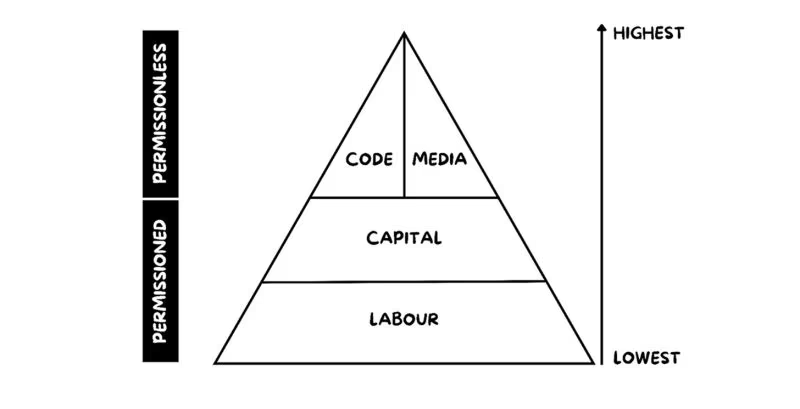
Naval Ravikant has a four-layer model of leverage that's worth starting with. Naval’s four layers are:
- Labor
- Capital
- Code
- Media.
Labor is the oldest form: directing other people to act on your behalf. Capital is the modern engine of compounding: deploying money into productive assets. Code and media share the top of the pyramid because they have near-zero marginal cost of replication. Once written, software serves another customer for almost nothing. Once recorded, a podcast reaches another listener for almost nothing.
Naval also splits the layers by whether they require permission or not. Labor and capital are permissioned: you need someone to hire you, fund you, or work for you. Code and media are not: you can produce either at midnight without asking.
The natural question for an operator in 2026 is where AI fits. Is it just another expression of code? Or does it deserve its own slot?
I think the answer matters more than people realize, because the framing changes what an operating company should do about it.
The Longer Stack
Naval's pyramid is succinct and useful, but it captures only half of the story. The deeper history goes back further, and each layer in that history is still doing work today.
Man does the work. (Embodied effort)
Man uses tools. (Mechanical leverage)
Man coordinates other humans. (Social leverage)
Man harnesses energy and machines. (Industrial leverage)
Man allocates stored resources. (Financial leverage)
Man replicates ideas. (Attention leverage)
Man makes logic executable. (Code leverage)
Man connects networks. (Internet leverage)
Man measures reality. (Data leverage)
Man directs synthetic cognition. (Cognitive leverage)
That's my rough genealogy, and it’s not intended to be a precise one. The point of writing it out is that each new layer didn't replace the previous one. It added to it. The agricultural revolution didn't eliminate physical labor; it pointed it at different work. The industrial revolution didn't eliminate organizations; it built more powerful ones. The software revolution didn't eliminate capital; it amplified its returns by orders of magnitude.
Each layer stacks on the layers beneath it, and the stack is what produces the compounding.
Naval's pyramid is a condensed version of the stack. The bottom is older, and most companies still live there.
Where AI fits
I started by thinking about where AI sits in Naval’s pyramid: is it just a better form of code, or is it something else? Is it its own layer on top of Code and Media?
My conclusion is this: AI is its own layer. It is not merely a faster version of code, and it is not merely a different kind of media. Code executes deterministic rules. Media replicates content. AI does something neither of them does on their own: it performs inference at scale, what we call cognitive work. It synthesizes. It translates between forms. It produces something similar to judgments under uncertainty.
But AI doesn't appear on the stack out of nowhere. It sits on top of code, data, and the internet. An LLM is software (code) that runs on training data (data) over a network (internet) and produces output that gets consumed through APIs (code, internet). Strip away any one of those underlying layers and the cognitive layer disappears.
This is the thing operators don't always feel in their bones. AI's leverage is real, and it's also entirely conditional. The cognitive layer can only operate on what the layers beneath it provide. For many people and companies, it’s just whatever they type into their prompt. For more advanced users, it might be the context and documents given to a project.
The Company That Buys AI Before Getting Its Data in Order
Here's a pattern I've seen across companies of varying sizes. A portfolio company in the $30M to $100M range buys Claude Enterprise subscriptions. The CEO is excited. The board approves. Within a quarter, everyone has access, and the question becomes: what's it actually doing for us?
What it does well: drafting board updates. Summarizing meeting notes. Producing first drafts of memos. Generating prose. All of that is real value. But is that the value the CEO was buying? Perhaps, in part.
What many CEO’s really want to buy is the next level up on the leverage pyramid: pattern recognition across operations, anomaly detection in financial data, and decision support on margin movements. Insight that scales beyond the operating partner's bandwidth. That value lives in the cognitive layer. But the cognitive layer needs something to ‘think’ about.
So the operating partner asks: what's our gross margin by product line, by month, for the trailing twelve months? And the answer is that finance has it one way, ops has it another way, and the accounting system disagrees with both. KPI definitions drift by department. Half the data lives in spreadsheets that get saved in folders: v1.2, v2.3, v2.6_DAVES_EDIT, etc. The monthly close takes 11 business days, and revenue restates twice a quarter.
The company doesn't have a reporting spine. It doesn't have a single source of truth. The data layer is broken.
You can drop an LLM into that environment, and the LLM will write very confident answers about whatever input you give it. What it cannot do is invent the truth about the business. It can only operate on whatever the system says is true. If the system is wrong, the AI is faster at being wrong.
The Leapfrog Argument
The strongest counter-position is the leapfrog argument: AI is different from previous layers because it can absorb the messiness underneath. You don't need to clean your data first, the thinking goes, because AI is robust enough to sort it out. Conversational interfaces will replace dashboards. Agents will read and clean the messy systems for you. The foundation gets built into the model.
There's a kernel of truth here. AI does compress some layers. Dump a few csv’s into Claude and let Opus 4.8 derive the insights. The results can be impressive. A coding agent can read across a fragmented stack and stitch together views that didn't exist before. The internet age took thirty years to build; AI can recreate parts of it in hours.
What it can't do is invent trust in numbers that don't exist. It can tell you that two different csv’s disagree, but it can’t tell you which one is correct. It can't define a KPI that nobody at the company has bothered to agree on. The leapfrog works for some layers. For others, it can actually create more confusion.
Those I've worked with who get the most out of AI investments tend to share a profile. Their companies already have the layers beneath in solid shape. The reporting is reliable, even if it's still somewhat manual. The data is trusted, even if it's not yet automated. There's enough coherence in the underlying system that the cognitive layer has something to act on. Where that coherence is missing, AI can become an expensive, and sometimes misleading, decoration.
By Hand or by C
Brass cleanup is the simplest version of the leverage problem: there was only one rung available. The Army didn't have access to a higher layer because, for that particular problem, no higher layer existed yet (or was shot down by our hypothetical CSM). The labor was the technology because there was no other technology. The soldiers didn't choose the lowest rung; they were standing on the only rung that had been built.
Companies today are not in that situation. They can start adding rungs and begin climbing. The only question is how high they want to climb on the ladder of leverage. They can stand up a modern data stack. They can build a reporting spine. They can deploy AI on top. What they actually have to decide is which rung to build next, which will make subsequent rungs easier to ascend.
Leverage is Accelerating
A man on foot can travel 30 miles in a day. A man on a ship, 100. A man in a car, 500. A man in a plane, 5,000. Each layer of leverage didn't just speed up the previous one; it opened up a new range that wasn't reachable before. Each new technology opened up a new order of magnitude.
Companies are no different. A company that has the stack underneath it can do things its competitors can't. Not just faster versions of the same things, but different things entirely. The operating partner who can ask any question of any number in the portfolio and get a trustworthy answer in seconds is working from a different map than the one whose CFO needs three days to assemble the spreadsheet. The CEO whose monthly close runs in a day and whose data is reconciled across systems can make decisions on a cadence that's structurally inaccessible to a competitor running an 11-day close. The gap doesn't close on its own. If left unaddressed, it continues to widen.
That's what's actually on the other side of the stack. Not a faster monthly close, but a different operating cadence. Not better board updates, but a different relationship between the operating partner and the company's reality.
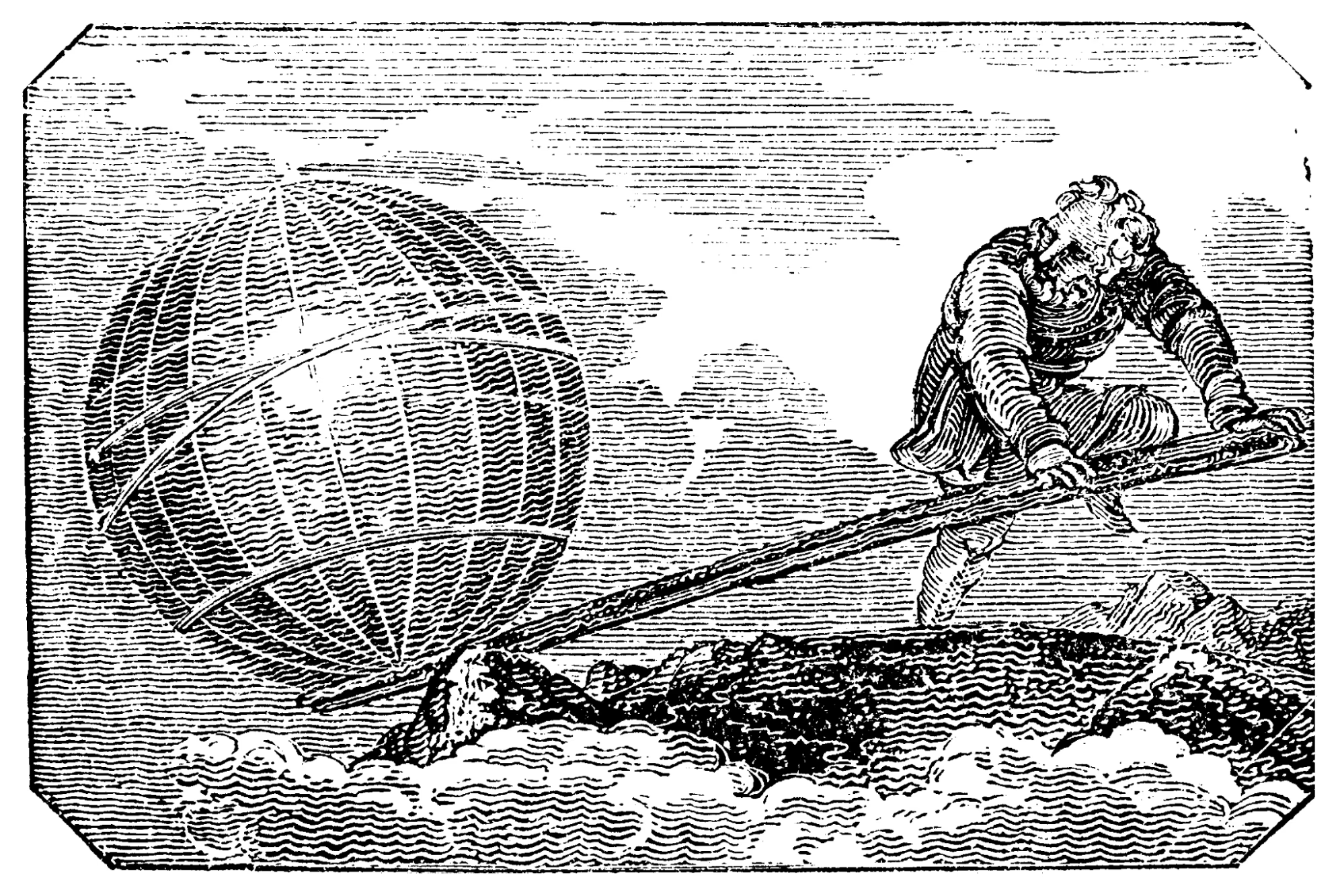
Archimedes is supposed to have said, "Give me a lever long enough and a fulcrum on which to place it, and I shall move the world." The right lever doesn't help you do an old job faster. It makes a different job possible.