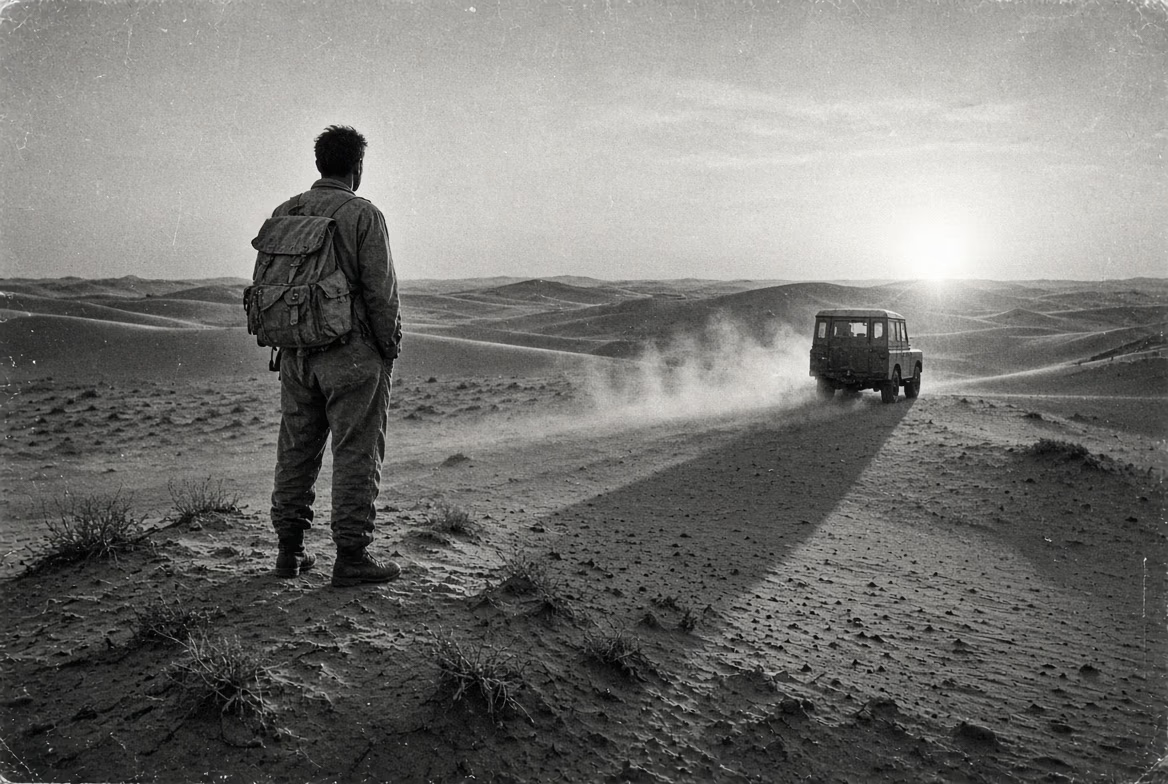
In 2017 I took a job abroad. I was fresh out of the Army, and after a few months job searching, all the US-based prospects I had seemed too… boring. I wanted the first chapter of my civilian journey to be just as adventurous as my time in the Army. That turned out to be the case, and then some.
In addition to the adventure, I ended up learning a hard lesson about concentrated risk. The employer sponsored my visa and paid to ship my household goods over, which is typical for many expat roles. I didn't think much of it. But there were two other things I didn't consider. First, in this particular country, there were effectively no other jobs for expats. The local jobs paid one tenth what an expat job did. Second, if I wanted to change jobs, it meant that I'd have to pay to move all my stuff back to the US and conduct both a job search and housing search at the same time, which presents a chicken-and-egg problem. It's impossible to rent or buy a home without a job, but it's tough to look for a job without a place to live.
Those may look like separate risks, but they all ran through one counterparty: the employer. So, when the company hit trouble in 2019 and suggested the senior leadership team take a pay cut to extend our cash runway, I didn't have much choice in the matter.
The Map and the Terrain
Written down, those four items make a reasonable risk register. The visa was sponsored and stable. The household goods were shipped and paid for. The local market was thin, but I had a good job in it. The exit to the US was expensive, but I had no plans to use it. Each row gets a modest likelihood and a manageable impact, and each one, taken alone, is a risk plenty of people carry without trouble.
The trouble was an assumption that list made without saying so.
A basic register tends to score its rows independently. It asks you to score probability and impact, and it records the answers as separate facts. When four rows depend on the same party, they aren’t really four separate facts. They are one big, concentrated risk recorded four times. A single event on the other side (a bad quarter, a funding round that closes late, a change in strategy) affects every row at once, in the same direction, all at once.
The risk register was the map, the abstract representation. The reality on the ground, the terrain, was much different, as I found out.
The map showed four manageable risks. The terrain had one counterparty. And the counterparty has an advantage I didn’t see: it was looking at a single relationship, so it saw the correlation by default. The party carrying the risks is managing four separate problems and sees four separate problems.
Examples like this in the business world abound. I want to go over two examples.
Landing a Whale Client
On November 4, 2013, GT Advanced Technologies, a New Hampshire maker of crystal-growing furnaces, announced a deal with Apple to produce sapphire in Mesa, Arizona. Apple would build the facility. GT would own and run the furnaces. Apple would advance $578 million to fund the buildout, which GT would repay over five years beginning in 2015. GT raised its 2014 revenue guidance to $600 to $800 million and said sapphire would make up roughly 80 percent of it.
Sounds like an incredible deal. Who wouldn’t want a deal like that with one of the most valuable and respected companies in the world?
On October 6, 2014, eleven months later, GT filed for Chapter 11. Looking at the structure of the deal, it looks a lot like my job abroad on a much larger scale.
First, the financing came from the customer: the prepayment was a loan, and the prepayment agreement let Apple demand the entire balance back if GT entered insolvency.
Second, the asset was dedicated: a plant in Arizona built around one buyer's program. The alternative buyers were contractually gone. According to the declaration that Daniel Squiller, GT's chief operating officer, filed in the bankruptcy, GT had agreed not to do sapphire business with any Apple competitor, or any supplier to one, for years.
Third, there were liquidated damages were $640,000 for each boule sold elsewhere and $650,000 a month for each furnace used for someone else. The exit was expensive by construction. With sapphire projected at four fifths of revenue, there was no other business to fall back on.
The asymmetry of the deal gets worse.
By Squiller's account, GT committed to produce at scale while Apple was under no obligation to buy any of it. GT could not change equipment, specifications, process, or materials without Apple's approval. Each late boule cost GT $320,000. When GT's executives objected during negotiation, Squiller says they were told to "put on your big boy pants and accept the agreement."
By the time of the filing, Apple had paid three of four installments, $439 million in all, and had withheld the last $139 million. Squiller's declaration called the deal "onerous and massively one-sided" and "a classic bait-and-switch."
That is one side's account, offered by an executive with every reason to blame the customer.
For its part, Apple called the statements defamatory and said it had bent over backwards to help. And GT was not only a victim. In 2019 the SEC charged the company and its former CEO with misleading investors, finding that GT knew by late April 2014 that it had not met Apple's standards while it kept telling the market it expected the final payment.
The settlement between GT and Apple, announced on October 23, 2014, had GT exit sapphire production and repay the $439 million from furnace sales over up to four years, without interest.
I’m not interested in assessing who was “right” in this case. Once GT missed the specification, every protection it might have had ran through the one party it had failed: Apple. There was no second customer to sell to, no financing outside of Apple, no plant outside of the Apple one, and no business outside the Apple contract.
A supplier with one of those dependencies has a bad quarter. A supplier with all four goes bankrupt. GT didn't take four separate risks. It took one, huge mult-layered counterparty risk.
Don’t Be a Chicken
Contract poultry farming looks like any ordinary business arrangement from the outside. Like many industries, it has a regulator: USDA. There are two parties to each contract: the grower (seller) and the integrator (purchaser).
In its November 2023 rule on grower contracting, the Department of Agriculture laid out the structure as follows: the integrator controls the supply chain from breeder genetics to slaughter. The grower owns the houses and builds them to the integrator's requirements, at a cost USDA puts at nearly $500,000 per house.
Growers with fewer than six years in the business carry debt equal to 51 percent of their assets, on average.
Under the tournament system that dominates the industry, pay is set by ranking growers against each other on metrics the integrator defines. During the contract, the integrator may require upgrades at the grower's expense. And about a quarter of growers reported that only one integrator was close enough to grow for, with another quarter reporting two.
Now, let’s run it through the same four risks as my overseas job post.
First, the financing is a loan secured by buildings good for one purpose. Second, the asset is houses built to one customer’s specification. Third, the alternative buyers, for half of growers, number one or two. Fourth, the exit means selling a specialized building to one of the very few buyers who need it.
No one in this picture has to behave badly for the leverage to land where it lands. The structure puts it there.
Why It Only Breaks One Way
The standard way to score a risk is probability times impact. For a concentrated position both numbers are estimates, and multiplying them can hide the thing that matters, which is the shape of the payoff.
Nassim Taleb's word for the dangerous shape is fragile, and in Antifragile he means something specific: a thing is fragile when it has more to lose than to gain from volatility, when its upside is bounded and its downside is not.
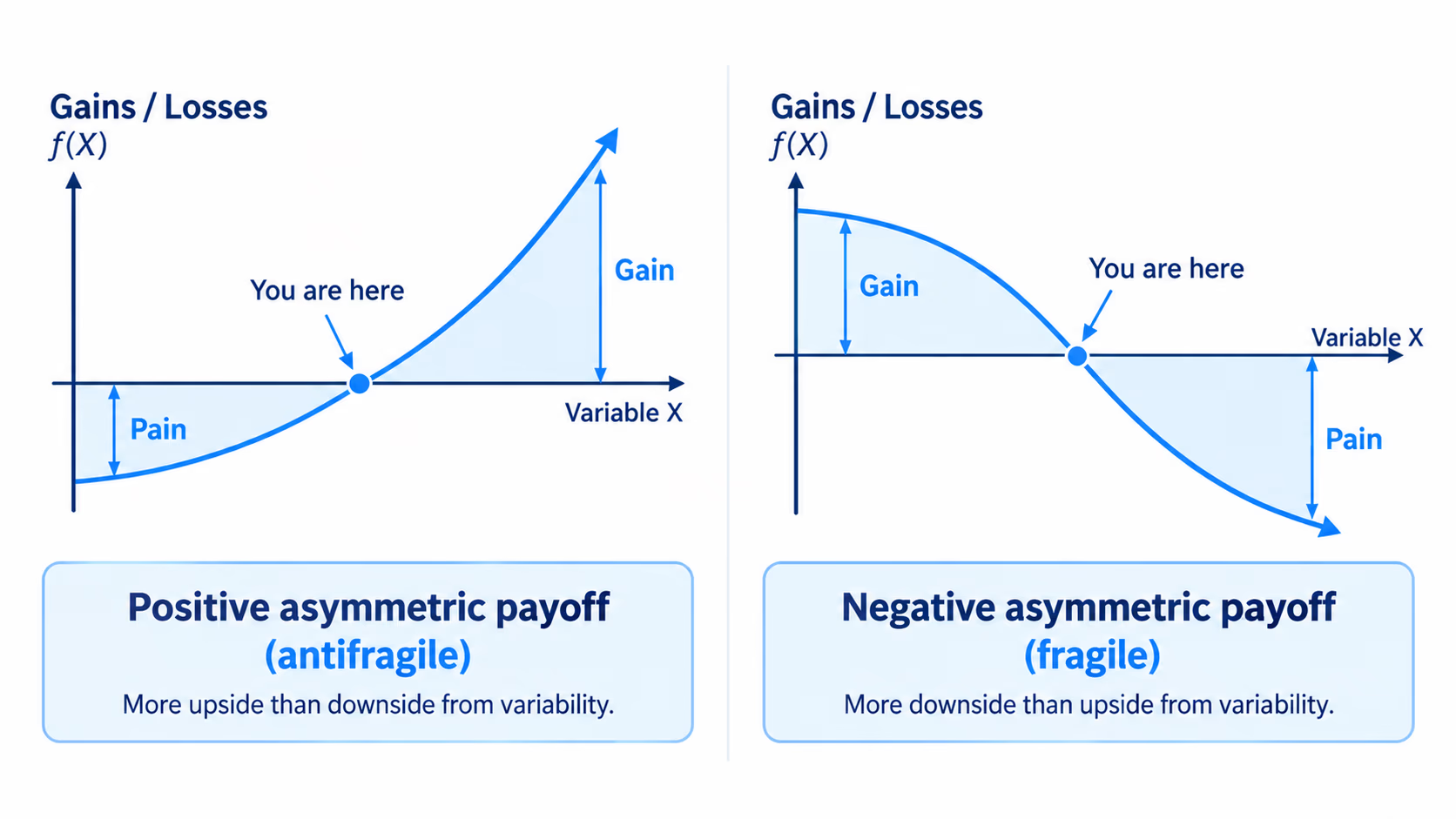
A position concentrated on one counterparty tends toward that fragile shape.
If the counterparty does well, the concentrated party earns the contracted price, which is bounded by the agreement. If the counterparty stumbles, the concentrated party takes the loss on every dependency at once.
GT's contract is nearly a perfect diagram of it. The upside was whatever Apple chose to buy, and Apple was not obliged to buy anything. The downside included a callable loan, per-boule penalties, and a plant with one customer.
None of this makes concentration the enemy.
Taleb's own prescription, the barbell, deliberately concentrates exposure at the extremes: put most of your position somewhere dull and safe, and put a small part somewhere wild. The question for any dependency is not only how likely it is to fail, but what the worst case costs and whether anything limits it.
Taleb's second idea fits just as closely.
Whoever holds the alternatives holds the option: the right, but not the obligation, to change the terms. Concentration doesn't destroy the option. It moves it across the table. When my employer asked for a pay cut in 2019, it wasn't taking anything it hadn't already been handed. The option had been sitting on their side of the table since the day I accepted the move.
The Case for Concentration
The strongest objection is that concentration is a necessary risk for big upside. Nobody advances $578 million to a supplier that plans to keep its capacity available to competitors. A grower gets a bank loan because the integrator's contract makes the loan bankable. An employer pays to move someone's life across an ocean because it expects that person to stay.
Commitment is what the other side is buying, and a party that insists on keeping every option open doesn’t get anyone’s best terms. Every arrangement above was entered by people with good reasons, and several produced years of good outcomes first.
All of that is true, and it doesn't remove the structural problem.
The distinction is between committing on one axis and committing on every axis to the same counterparty. A single commitment is a trade. Four commitments to one counterparty is a surrender that looks like four trades, because each was negotiated separately and each, alone, was reasonable. The useful question isn't whether to commit. It's how many things have to exit through the same door at the same time.
Nor does the argument say to avoid large partners, refuse customer financing, or assume the counterparty acts in bad faith.
And the Case Against It
Concentration hands the counterparty an option. It doesn't decide how the option gets used, and two conditions can make it survivable.
The first is mutual dependence. In a 1983 paper in the American Economic Review, "Credible Commitments: Using Hostages to Support Exchange," Oliver Williamson argued that specialized investments can be safe when both sides make them, because each side's investment works as a hostage to its own good behavior. Mutually assured destruction. Ride or die.
If the counterparty is as tied to the relationship as the other party is, neither can squeeze without hurting itself. GT failed that test badly. Apple could put glass on a phone without GT. GT could not sell a Mesa plant's output without Apple.
The second is time. In The Evolution of Cooperation (1984), Robert Axelrod called the probability that two parties will deal with each other again the shadow of the future. When that shadow is long, the value of the future rounds outweighs whatever could be taken in this one. Cooperation can hold without anyone enforcing it. Simon Sinek has called this concept playing an Infinite Game.
The shadow doesn't have to come from the two parties alone. In a small, closed community, how one member treats another becomes known to everyone else, so every deal between members is a round in a much longer game.
Poultry shows where this protection can work. The integrator and the grower meet every flock, which is as repeated as a relationship gets. But with only one or two integrators in range, the grower can't credibly walk away, so the repetition secures the integrator's position rather than the grower's.
Neither condition shows up on the risk list. A register can say how concentrated a position is. It can't say whether the counterparty is concentrated back, or whether it expects to be around, and cares to be, for the next round.
Eighteen Months Later
I moved back to the US. About eighteen months later, I went back to work for the same company, this time remotely.
It was the same counterparty with one dependency instead of four. No visa. No household goods on the far side of the ocean. No local market to be caught in, and no chicken-and-egg problem waiting at the exit. If things went badly a second time, I would lose a job, which is a real loss but a single one. The downside now had a floor.
The company’s CEO also did something the structure never required it to do. It paid back the salary I had given up in 2019, with 9 percent accrued interest.
The concentration had handed them the option, and the way they exercised it showed who they were. In hindsight, it shouldn't have surprised me. The CEO and a few of the people there had come out of the same Army unit I had. I didn't know them well before joining the company, but they weren't strangers. And in that community a reputation follows a person for decades. Every decision between us was a round in a game far longer than one job.
That cuts both ways, and it is the part a list can never capture. The shared background is a large part of why the story ended well.
I didn't think much about the structure going in. Maybe because I didn’t fully understand concentrated risk. Or, maybe because familiarity did the work that analysis should have done, and it happened to be right. Concentration is a bet on the other side's character. The first time, I placed that bet on four axes with people I knew mostly by reputation. The second time, I placed it on one axis, with people who had shown me firsthand how they played the long game.
The counterparties worth concentrating on are the ones that expect another round. And the only reliable way to find them is to have dealt with them before everything rode on it.
What I kept from those years was a rule about risk and sequencing: one move at a time, even when the move is the right one.