We Want AI, But Where Do We Start?
The most common challenge I hear from operators that want to implement AI in their business is that they don’t know where to start or which solution to use. They have a strong intuition that AI can help solve some of the most challenging, or most annoying problems in their business, but there are so many tools on the market that they don’t know which one is right for them.
Years of historical tickets that have limited comments or inconsistent classification issues. Messy financial and accounting data seems well-suited for an AI solution. The quarterly board reporting pack that somehow still takes three people and five days to assemble - even with Claude doing the heavy lifting - feels like it’s a place AI could help.
Nearly all of these operators are using AI in their individual workflows and seeing positive results, typically in the form of advanced Claude techniques: projects, skills, co-work, and Claude code.
But when it comes to the problems that would help move the business forward, they remain at a loss.
For most companies, AI remains an individual productivity tool. The results are highly dependent on the skills of the person using it, and most companies only have a handful of people who know how to use it well.
That makes broad AI subscriptions expensive and inefficient to roll out to a large percentage of your employees.
So where should an operator that wants to implement AI to transform their business start?
Individual AI vs. Enterprise AI
First, it’s important to distinguish between individual AI productivity tools and Enterprise AI use-cases.
Most companies are not experimenting with AI. They have individual employees experimenting with AI for their individual workflows.
I’m not critiquing that or saying it doesn’t have value. Quite the contrary; just a handful of highly productive AI power-users can have an outsize impact on a company. I’ve seen it first-hand.
But that’s the equivalent of having an incredible VP of Finance who’s a wizard with Excel. He may build incredible financial models and deliver remarkable strategic insights to the CEO. That doesn’t mean the company has “advanced enterprise Excel capabilities.” It has one all star who can use a tool well.
What does an enterprise use-case look like?
An enterprise AI use-case is one that runs across an entire process which involves multiple people and often multiple systems. It doesn’t just transform how an individual works; it transforms how entire teams work.
Stack enough of these use-cases on top of each other and AI can transform the way an entire company operates.
Most companies are not ready or capable of building an enterprise AI use-case, which is why 95% of AI pilots fail. They try to start with a point solution when they lack the structure to support it.
These companies are trying to navigate complex terrain without a proper map or compass, and they immediately end up lost.
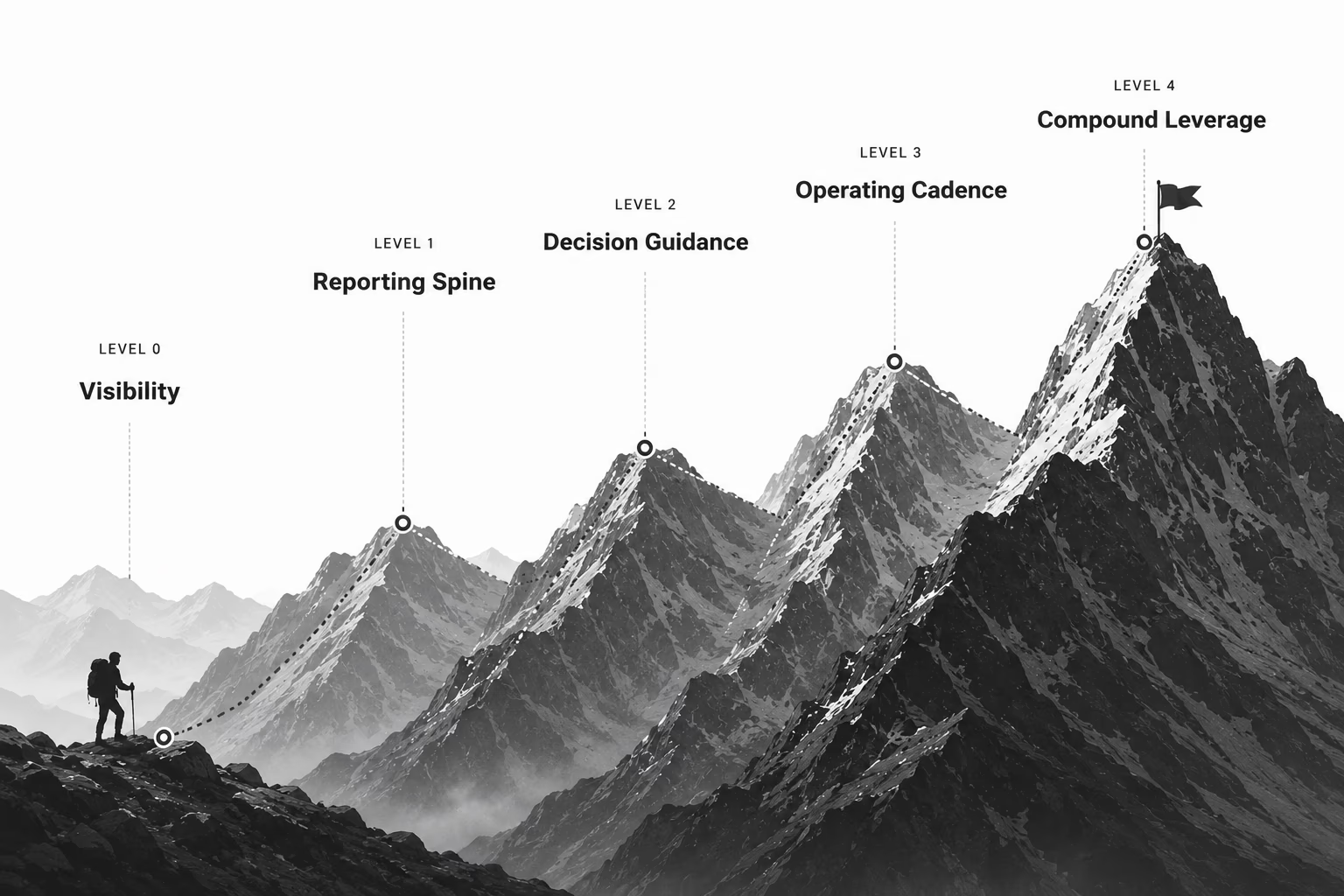
Below I’ll outline my version of the map that companies should use to navigate the climb towards enterprise AI. Like doing anything advanced, it requires getting the boring basics in place first.
Developing the Map
I began developing the idea of a capability pyramid while working on the Enterprise AI team at ServiceNow. Leadership was eager to push AI into every corner of the business, so we had a huge backlog of use-cases to build, pilot, and implement.
Like any fast-moving effort, some of the use-cases succeeded and others failed. We also had use-cases that “worked” as intended, but didn’t deliver enough value to justify the effort or cost. The ROI wasn’t there.
It didn’t take long to realize that the use-cases that succeeded were the ones that stood on top of our most robust historical data sets - data sets that earlier data science and engineering teams had spent years capturing and curating. Customer case data; sales pipeline; marketing analytics; net revenue retention; remaining performance obligation (RPO).
Other areas were less mature or lacked meaningful historical data sets; still others lacked consistent metric definitions, or had undocumented changes that meant comparing two numbers was meaningless.
The same solid data and consistent definitions that helped provide basic visibility to leadership also proved to be the prerequisite for enterprise AI use-case success.
In the spring of this year, I participated in Palantir’s inaugural American Tech Fellowship for Veterans, where they taught a Levels framework for Palantir deployment success in the world's largest organizations.
The Aptum AI levels are an adaptation of the insights I gained at ServiceNow, the framework taught by Palantir, and my work with companies in the lower middle market.
The Aptum AI Levels
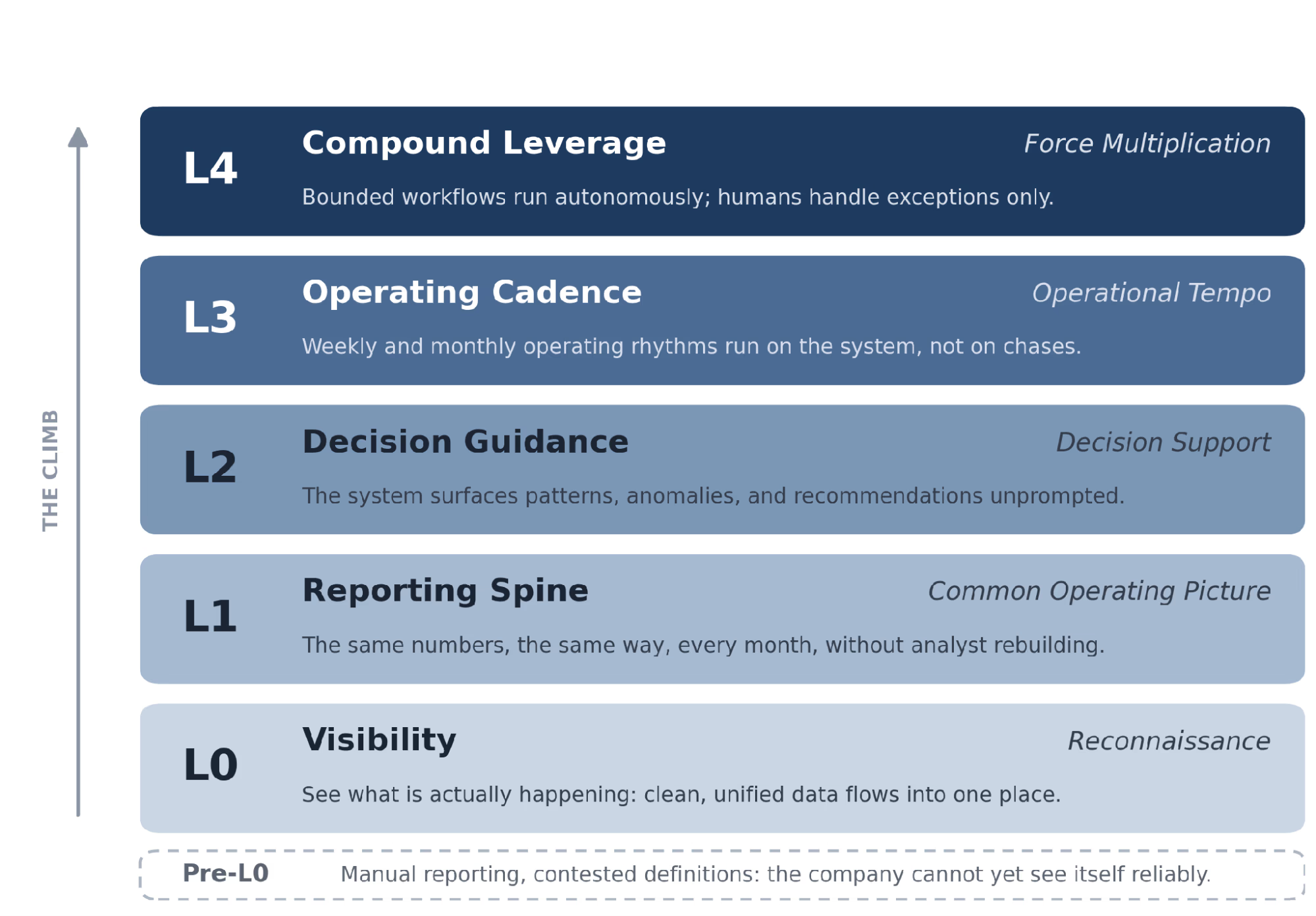
The Aptum AI Levels are a data and AI maturity framework to help companies identify where they are on the map and what they should do next.
It starts with getting a solid data foundation in place that lets a company see itself clearly and consistently. In my experience, that is often more valuable than a narrow AI point-solution, though few companies want to hear that and deal with that reality.
The ones that do put that foundation in place find that they are able to make steady progress which accelerates and gains momentum over time.
Below is a detailed description of each of the levels.
Level 0: Visibility
At L0, the company's operating data exists, gets captured where the work happens, and can be seen. That sounds like a low bar. Most sub-institutional operating companies I've seen are actually below it.
Below L0, month-end is a project, and usually not a smooth one. The numbers exist only in the sense that they could be assembled, by a particular analyst, from particular exports, with judgment applied in places that aren’t well-documented.
Achieving L0 typically involves building a data warehouse or data lake with automated pipelines. Numbers flow from systems-of-record automatically, and KPI definitions are fixed in the code, not a manual filter or judgement.
The anti-pattern I see most commonly is the analyst raid: the monthly expedition across exports and spreadsheets to drag the numbers back to base camp. Even if the modern version of this arms the raiding party with AI, and the raid gets faster, it’s still pre-L0. A faster raid is not visibility, and it won’t compound.
For a company with strong systems-of-record, establishing L0 is usually straightforward. The systems of record already capture key workflows and data, and L0 involves building automated pipelines from those systems into a data warehouse.
That process often surfaces data or definition-related issues which require changes or improvements to the upstream process. Building the L0 data substrate is often a forcing-function for more rigorous definitions and business processes.
Level 1: Reporting Spine
L1 is fundamentally based on trust in the numbers, and it’s built on top of the L0 data substrate.
The same numbers, the same way, every month, without an analyst rebuilding them. The definitions are standardized in code and no longer the subject of debate. The CFO’s numbers match the COO’s numbers by default.
Another feature of L1 is a stable baseline, and a stable baseline is what makes variance visible. This enables companies to begin to see the spread, not just the average.
L1 doesn't just enable the company to report numbers to the board better, though it certainly does that. It also enables the company to report to itself. L1 unlocks true data-driven decision making.
The anti-pattern I see most often is the dashboard mirage: a company that looks like it has data and numbers, but lacks consistency. Dashboards multiply easily, but the numbers don’t always agree. This is usually the result of teams using different back-ends for the data, or building custom filters, which amount to custom KPI definitions.
The question isn’t just whether reporting exists; it's whether the reporting is solid enough to be load-bearing.
It’s worth noting that neither L0 nor L1 mention AI, and that’s one of the key insights of the Levels framework: foundation first, AI second.
Level 2: Decision Guidance
L2 is when the foundation put in place at L0 and L1 starts to open up new possibilities.
L2 is about leveraging AI and machine learning to surface patterns, anomalies, and recommendations on top of the reporting spine. This is not more reporting, but a layer that surfaces insights that would have been invisible to the human eye.
Attention gets allocated by signal instead of by habit.
Many of the examples that meet Level 2 predate the current generative AI wave:
- Revenue forecast models based on historical pipeline conversion trends and current pipeline numbers
- Upsell and cross-sell opportunities based on customer buying signals
- Customer churn risk based on usage or ticket patterns
At L2, a company can move beyond better, faster data to insights that actually improve revenue and EBITDA.
If every insight in the company still begins as a human question, you have good reporting but no decision guidance. You're at L1 with ambitions.
The anti-pattern is the bolted-on copilot: a new gen-AI feature inside your CRM, or another SaaS product, that allows employees to ask questions. I’m not saying not to use these features if they become available. But, don’t mistake this as true Level 2 decision guidance.
The climb to L3 is where the guidance stops being commentary. Pick one recurring decision, make the system's read the starting point of that decision rather than an appendix to it, and rebuild that piece of the workflow around what the layer can now see.
Level 3: Operating Cadence
L3 is when the rhythm of the company starts to run on the system.
AI sits in the loop of recurring decisions: the Monday call starts from the system's read, the monthly review interrogates the anomalies it surfaced, the handoffs between functions run through it rather than around it.
The unit of progress at this level is the redesigned workflow. It is never the attached tool. Designed in is the entry requirement, not the aspiration.
The pass condition is a thought experiment you can run today: if the system went dark on Sunday night, would Monday's operating meeting still happen exactly as designed? At L3 the honest answer is no. The cadence would visibly break, because the cadence is built on it.
The anti-pattern is an analyst leveraging individual AI tools to produce the cadence, usually by dumping csv’s and a slide template, along with a detailed prompt, into Claude or ChatGPT. This is an improvement over a team of analysts doing things manually, but it’s not L3. In fact, it tends to lull teams into a sense of complacency that they’re “using AI”, but it lacks the consistency and structure to become load-bearing.
Once L3 is in place, the climb to L4 involves selective subtraction: remove the human from loops that have earned it. Earned means the loop has run at L3 long enough that its failure modes are known, acceptable, and rare, and the exceptions have somewhere to land.
Autonomy is granted per workflow, and only ever downstream of trust built at the levels below.
Level 4: Compound Leverage
L4 involves building autonomous workflows with humans intervening only for exceptions, or at pre-defined decision points.
These workflows complete end to end with no human touch on the most basic path, while people handle the cases the system surfaces for input.
The anti-pattern usually shows up as a premature agent use-case: an agent running over incomplete, inconsistent, or contested data will produce results that look similar on the surface to one running on sound foundations. However, the results will be unreliable, it will make poor decisions or mistakes, and likely end up being sunset eventually.
It’s worth noting that L4 isn't a finish line. It’s a company capability where the spend compounds and you own what compounds. L4 has to constantly be re-evaluated as models improve and the business landscape shifts. I’ve written before about how to ensure that L4 produces compounding value that you own.
The Case Against Skipping
Every operator wants to start at the top. I understand why.
Every amazing AI demo lives at the top; L3 and L4 are what the board has seen on stage, and everything below them is unglamorous, invisible in the short-term, and impossible to show off at a conference.
But each level is load-bearing for the one above it, and the failures I've spent this arc documenting are, in the end, one failure: the climb attempted out of order. An agent deployed on an illegible company fails in both directions at once, acting on data the company doesn't trust while the company lacks the data substrate to detect it easily.
Using decision guidance on untrusted data can actually increase the gap between the map and the terrain: wrong answers, delivered faster, with more confidence. It’s a well-known failure mode for AI.
Skipping levels isn't a shortcut that sometimes works. It's the mechanism that puts you in the 81 percent of companies that get no value from AI.
Two Honest Objections
The first objection is the one I'd raise myself: maturity models are an oversimplification of real companies. The sales function may have robust guidance running while finance is still running analyst raids; a greenfield division stands up L1 from the start while a legacy department is struggling to put L0 in place.
These can all be true. Unevenness is the normal condition.
And the greenfield case isn't level-skipping at all: a new division starts clean because there's nothing contested to reconcile, so it builds L0 and L1 in a month at limited cost.
The Aptum AI Levels map is designed to sequence investment, not to grade companies as a whole.
There is another common, and valid objection: not everyone needs to reach the summit. A stable services business with decision guidance working at L2 might stop there because their competitive advantage depends more on execution.
The framework prescribes sequence, but the right destination is a decision the company leadership must make.
The key point is the order in which you climb, because the wrong order leads to failed programs and wasted money.
What the order buys, beyond avoided failure, is compounding.
Each level makes the next level easier to reach: the spine makes guidance nearly free to try, guidance makes cadence a redesign problem instead of a data problem, cadence makes autonomy more about subtraction than adding new capabilities.
So the distance between an L1 company and an L4 company isn't a fixed gap. It's a difference in traveling speed, and differences in traveling speed widen on their own.
The companies a level ahead of you aren't one level ahead. They're one level ahead and accelerating.
Where You Are, Actually
The abbreviated placement test. Take one workflow that matters (order-to-cash, service intake, the forecast) and ask five questions.
- Can you see it? Yesterday's numbers, today, without sending anyone to get them.
- Do you trust it? The same numbers, the same way, every month, with nobody rebuilding them by hand.
- Does it tell you where to look? Name the last insight you didn't have to ask for.
- Does the work run on it? If the system went dark tonight, would the next recurring meeting break?
- Does it run without you? Zero touches on the happy path, humans on exceptions only.
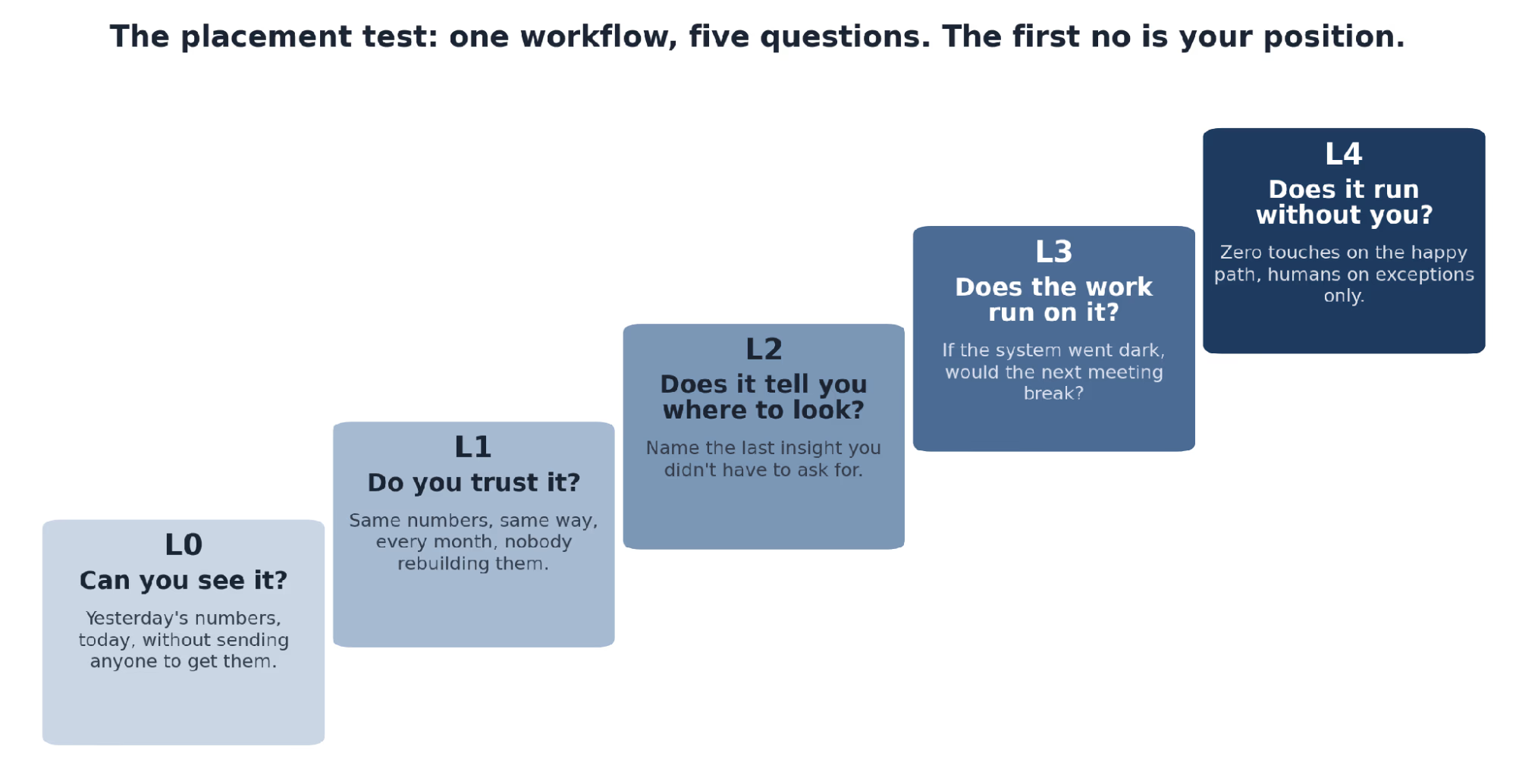
The first no tells you your position. The transition work at that level is your next best move, and everything above it can wait, because attempting it now would be a waste of time and money.
It’s worth pointing out a few things that were absent in this discussion: model choice never came up. Neither did vendors, or agents.
These questions are questions about position, because position is what is necessary to set your azimuth.
Want to read more about the Levels? Check out these resources:
Find your Aptum AI Level — free five-minute diagnostic