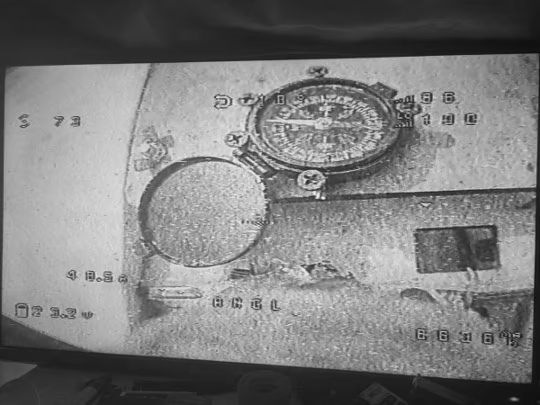
In July 2026, a Ukrainian radio-technology specialist named Serhii Beskrestnov, who advises Ukraine's Ministry of Defense, reported that Russia's Molniya attack drone had been fitted with a magnetic compass. Not a new guidance package, not a fresh satellite receiver. A magnetic compass, screwed to the airframe. The drone's camera was programmed to periodically tilt down to look at it as a workaround for the jamming of GPS and GLONASS that is now common.
This was more than pure improvisation, trying to get by with limited resources. It was intentionally leveraging cruder, simpler tools in place of more advanced ones. But the interesting question is not how crude the compass is. It is why the simple, crude thing works when the advanced satellite does not.
What Survives Denial
A magnetic compass has no signal to jam. It's not perfect and is wrong in known ways: declination, a bolt of nearby metal, the tilt of the platform it rides on. Known-wrong is a workable condition as long as the errors are stable and can be corrected for. GPS is precise when it works, but its failure is not merely degraded precision. A jammed or spoofed receiver doesn't report that it is lost at all. It reports a position, and that position is delivered with the same confidence whether it's right or wrong. The compass failure still gives you "roughly this way." The GPS fails with a specific, wrong, trusted number.
The drone designers made a trade that looks backwards. They gave up precision they could no longer count on for an instrument whose worst case is a few degrees of drift. A compass off by five degrees is a bounded problem. A receiver off by fifteen kilometers, insisting it is on course, is an unbounded one. They did not choose the better instrument. They chose the least worst case.
The Instrument the Army Put Back
In 2018, the U.S. Army dropped land navigation from its Basic Leader Course, the school sergeants pass through on the way to a leadership position. The reason was that the hours were needed for classroom instruction, and every soldier had GPS anyway. Map reading, compass work, and pace count came off the program because they had started to look like an "outdated skill on the modern battlefield."
I know all my SF brothers are probably screaming at the screen just reading that.
Well, their screams have been heard. The Army put it back into the curriculum in 2024. The reason its instructors gave was the one the Molniya drone example makes concrete: in a large-scale fight, electronic positioning devices are "likely to lose their reliability due to enemy interference and technical issues." The modern battlefield, like the pre-modern one, puts a premium on the skill soldiers need when GPS is jammed and they have to fall back on a compass.
The compass has not improved during the intervening years. The environment has gotten more hostile, and the crude tool is the only one that still reliably works.
The Organization's Version
Many organizations have a quieter version of what the Army did.
It runs on a preferred instrument stack that replaced a previous, less sophisticated stack. The preferred instrument could be a dashboard, a forecast model, or a pipeline in the CRM: precise, legible, expensive to build, and satisfying to read. The crude one is the bank balance, the count of signed contracts, the number of trucks that left the yard this morning. The crude instrument is one you can't put in a board deck. But, it's impossible to jam, because it doesn't depend on tools that can go down.
When the preferred instrument becomes unreliable, and it does so quietly (a data migration, a vendor swap, a model version that shifted its definition of a "qualified" lead), the dashboard doesn't always announce that it is lost. Like the GPS, it keeps reporting a position. A broken pipeline is survivable in proportion to whether anyone in the building still knows the crude number without asking the system for it.
The organizational equivalent of the camera tilting down is a person whose job includes checking the crude count against the sophisticated one on a cadence, before anything breaks, not after. That role is unglamorous and usually unassigned, which is why the fabrication can run for a month before someone notices the dashboard and the bank balance stopped agreeing.
A Fallback, Not a Downgrade
None of this is an argument against the advanced instrument. The drone still wants GPS when it can get it, and satellite navigation beats a compass on every day the signal is clean, which is most days. The advanced stack is worth the money it costs to build well. That is the work I spend my days on, and I am not about to argue against it.
The argument is narrower. An instrument that cannot be worked around is a dependency, and a dependency that can be denied is a risk, whatever its precision on a good day. The compass does not replace the satellite. It is there so that losing the satellite is a bad hour instead of a lost aircraft. A fallback is not a step backward. It is the price of being allowed to depend on the sophisticated tool.
Where the Analogy Breaks
A compass gives heading, not position. The drone still has to dead-reckon from a known starting point; the compass alone will never tell it where it is. The crude business number has the same limit. The bank balance reveals money at a moment in time, and whether it's within expected limits. If it's not, it doesn't reveal which of forty assumptions is wrong.
Still, that is enough. The only job the crude instrument has is to say that the sophisticated one is not working as expected.
The camera tilts down. Not because the compass is better than the satellite, but because it is still there when the satellite is taken away. The question worth carrying is not which instrument is most precise. It is which one keeps working after the jamming starts, and whether anyone has practiced reading it.
Many business operations would benefit from a bolt-on compass that someone checks periodically.